
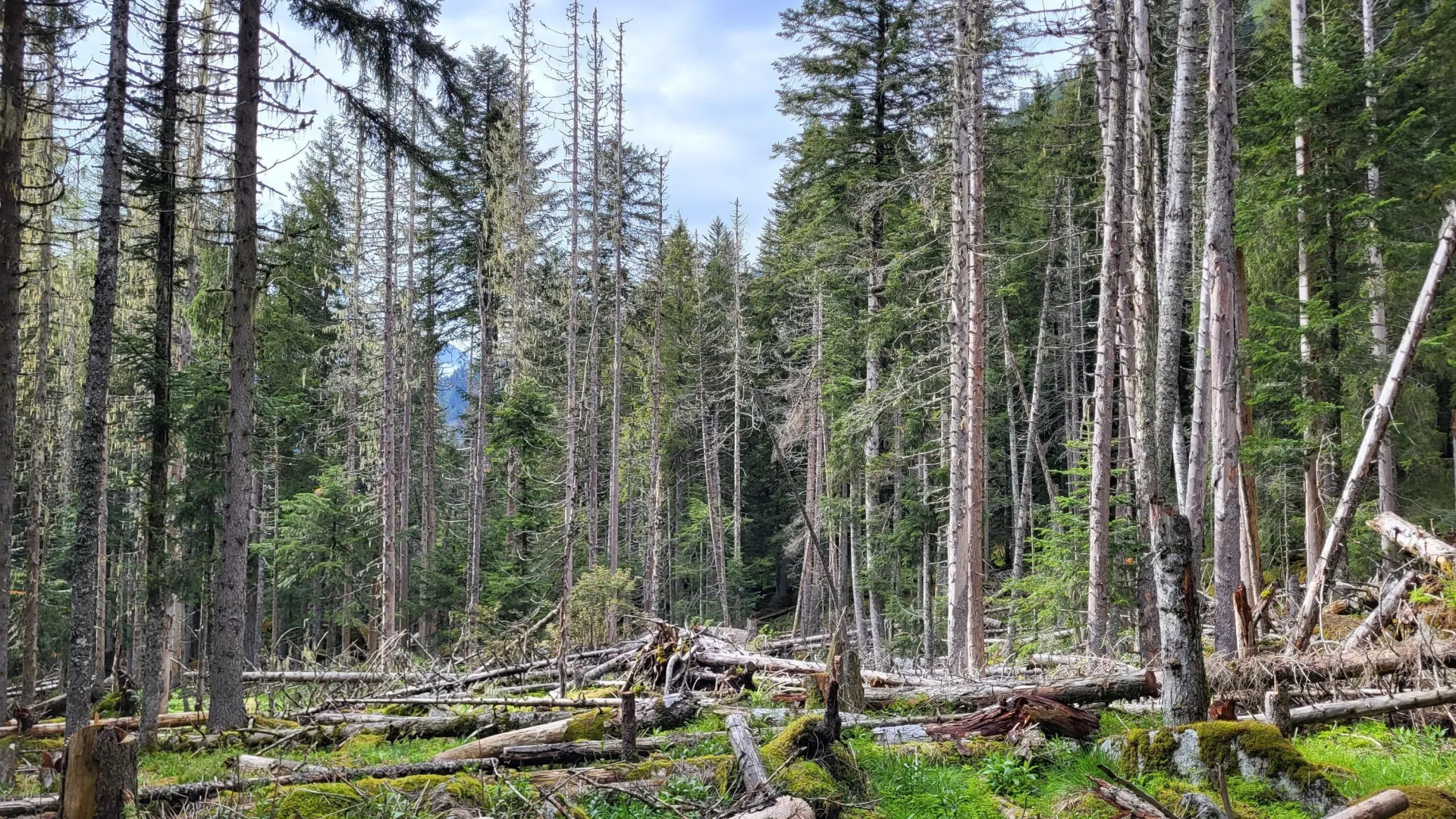
Drought: How Climate Change Is Affecting Switzerland's Forests
Drought is one of the biggest challenges facing Swiss forests. Climate change is leading to an increase in heat waves and prolonged dry spells.
The consequences are clearly visible: Trees are experiencing water stress, growing more slowly, and becoming more susceptible to pests such as bark beetles, as well as to diseases and wildfires, as is currently the case above Locarno in Ticino.
(Current forest fire risk map from the FOEN)
In mountainous regions, spruce trees are particularly affected by the changing conditions; at lower elevations, it is the beech tree that suffers from “fever". But other tree species are also increasingly affected. Experts have been observing for years that the condition of Swiss forests is deteriorating and that the composition of the forests is changing over the long term. To preserve the forest’s diverse functions—as a habitat, CO₂ sink, source of timber, and recreational area—climate-resilient tree species, near-natural mixed forests, and sustainable forest management are becoming increasingly important.
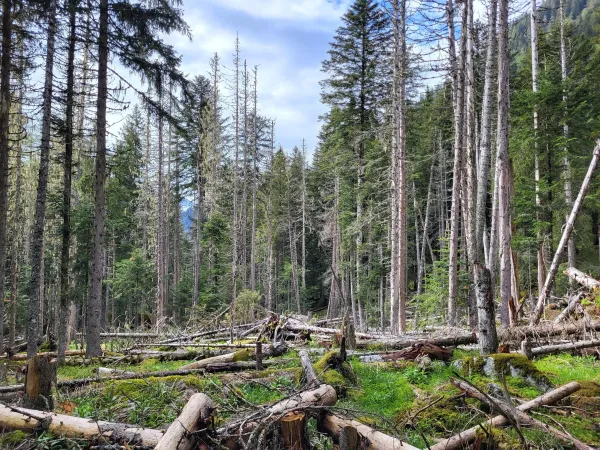
Trees in Soazza GR, that were infested by bark beetles during a drought
In 2022, the Federal Council adopted the report on forest adaptation to climate change . The report outlines measures to support the forest’s adaptation process, as well as the parties responsible for implementing them.
The effects of drought and climate change on forests are well documented scientifically. Models are increasingly able to show what the future holds for forests. Also, artificial intelligence is increasingly being used for this purpose, as shown in a new study in the journal Science, which simulates European forests in the year 2100.