
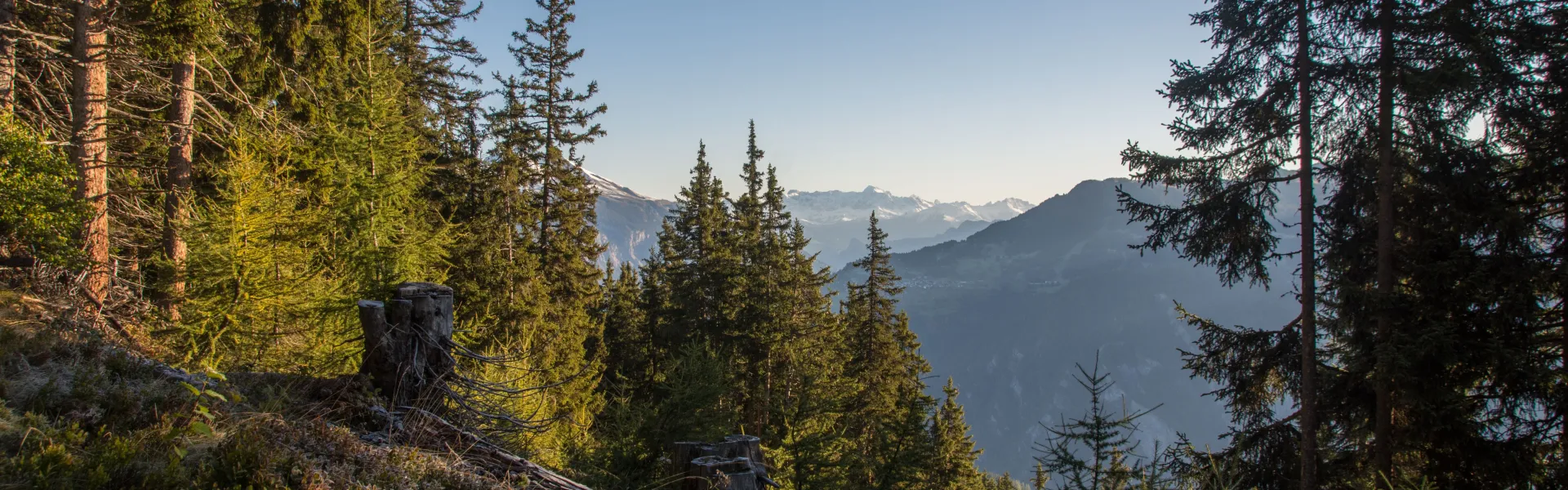
Mountain forest
From time immemorial, we have depended on the mountain forest as a protective forest. It protects us from avalanches, rockfall, erosion and floods. At the same time, it serves as a habitat for numerous animal and plant species, as a recreational area and as a source of wood. As an important carbon sink and supplier of clean air, it also plays a crucial role in the fight against climate change.
The diverse services of the mountain forest
The mountain forest filters the air, stores carbon and is therefore good for the climate.
The mountain forest provides a habitat for around 25,000 different animal and plant species - many of which are endangered or rare. In densely populated Switzerland, it is one of the last green islands and a hotspot of biodiversity.
Mountain forests are closely intertwined with the Alps, pastures and agricultural land. Over the centuries, a cultural landscape of high ecological diversity and great value has been created. However, with the decline in traditional use, many areas are becoming overgrown, biodiversity is decreasing and the landscape is losing structure and diversity. This diversely structured cultural landscape must be preserved.
The mountain forest acts as a natural regulator: it prevents avalanches, absorbs rockfall, stores water and stabilizes the soil. In this way, it not only protects the Alpine valleys, but also the Central Plateau, cities and economic centers through its flood regulation. 44% of the Swiss forest has a protective function - and thus secures over 130,000 buildings and thousands of kilometers of paths, roads and railroad lines.
In addition to its ecological importance, the mountain forest is also a place of peace and relaxation. Hikers, sports enthusiasts and those seeking relaxation will find nature experiences, spirituality and a break from everyday life here.
Wood harvested from the mountain forest is a renewable and climate-neutral raw material. It is used in a variety of ways - in construction, for furniture and pulp and as a renewable energy source - and creates regional jobs in the process. In its installed form, wood stores CO₂ for decades, often even centuries.
Threats
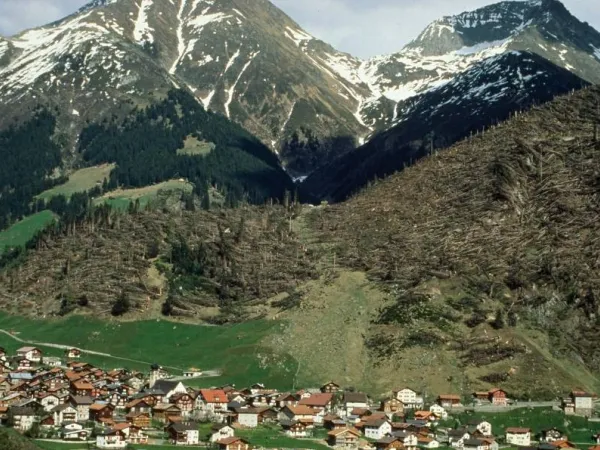
Mountain forests are under great pressure today. Climate change with rising temperatures and increasing drought is weakening many forest stands, while harmful organisms and storm damage continue to increase. Longer dry spells and more frequent extreme weather events are putting trees under severe strain - warming is occurring faster than a generation of trees can adapt (see Forest Report 2025).
At the same time, mountain forests are structurally weakened in many places. Numerous stands are the result of previous overexploitation or are monocultures, mostly of spruce. Other mountain forests have only recently emerged as a result of structural change in the mountain regions - for example as a result of the abandonment of the Alps and the scrub encroachment of former alpine meadows - and are usually still unstable in the first generation.
Excessive game populations also make natural regeneration more difficult and hinder the development of site-appropriate, climate-resistant tree species such as deciduous trees or silver fir. Pollutants, recreational pressure and invasive neophytes are also affecting the mountain forest.
Natural forest management is enshrined in law in Switzerland, but forest areas continue to decline worldwide - protecting mountain forests therefore remains a task of global importance (see Forest Declaration Assessment 2025).
Mountain forests also face economic and social challenges. Low, globalized timber prices and high management costs make the maintenance of many mountain forests unprofitable, while at the same time society's expectations of the diverse services provided by mountain forests continue to rise.
Care and responsibility
Disturbances such as windthrow, drought or beetle infestation are part of nature and are part of the natural life cycle of the mountain forest. From an ecological point of view, they are part of the cycle - over time, the forest renews itself, provided no external influences prevent this.
For us humans, however, such events become a problem if, for example, the mountain forest can no longer fulfill its protective function or no more wood can be harvested. Wind, snow, fire or insect calamities such as the bark beetle can destabilize entire forest areas or destroy large areas. If the protective trees in the protective forest are missing, it can be dangerous for people and infrastructure. In addition, the wood is lost as a renewable and climate-neutral raw material.
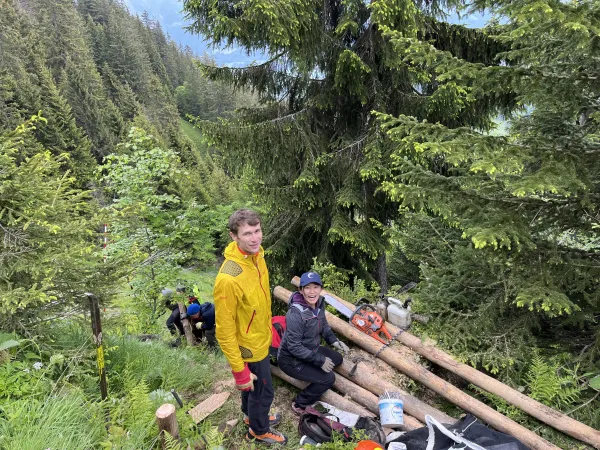
A forest left to its own devices is not geared towards the protection needs of humans. This is why it needs care - so-called near-natural silviculture: targeted interventions that maintain the stability of the mountain forest, ensure its protective function and promote natural regeneration. The aim is not to control nature, but to support it - so that the forest can continue to provide its many services for people and the environment in the future.
This is where sustainable forestry comes in: Promoting natural regeneration, young forest management, thinning and targeted timber harvesting help to prevent natural collapse. Forest management means supporting and strengthening the forest so that it can fulfill its functions for humans - similar to a garden that needs to be tended in order to produce a yield. Only in this way can the mountain forest retain its important role as a protective forest, timber supplier, habitat and CO₂ reservoir in the long term. Planting is merely an emergency measure: it is expensive and ecologically sensitive.