Worth knowing & frequently asked
What can you expect during a project week? What work will be carried out, what should you take with you and what does a typical day at the Bergwaldprojekt look like? Or do you have any questions about donating to the Bergwaldprojekt's work?
A compact summary of all important information about project weeks and answers to questions about donations can be found here.
Information on project weeks
A week in the Bergwaldprojekt is not a vacation job for late risers.
Projects for adults start on Sunday afternoon with an introduction and round of introductions. From Monday to Friday, the day starts at 6:30 am with a hearty breakfast, followed by work in the forest until around 5 pm. Snack and lunch are taken in the forest. A half-day forestry excursion is also part of the program. In addition to working in the forest, the volunteers also take on household tasks. On Saturday morning, the tools are cleaned and maintained and the accommodation is tidied up before the return journey.
Projects for school classes and youth groups begin on Monday with the arrival, an introductory round, followed by lunch and the first work assignment in the forest. From Tuesday to Thursday, the day starts at 7:00 am, breakfast is served at 7:15 am. From 8:00 am, the young people work in the forest, supervised and catered for by the Bergwaldprojekt, until at least 5:00 pm. A half-day excursion on forestry topics is also part of the program. On Friday, the final work in the forest and the cleaning of tools and accommodation are on the agenda. This is followed by a final round before the journey home begins.
In principle, participation is possible for everyone. Forestry knowledge is not required, but a good physical condition and sure-footedness are important. Some accommodation can only be reached on foot (one to two-hour climb with luggage); appropriate fitness is required. If this is the case, it will be noted in the respective project description.
The work in the mountain forest is varied and depends on the current forestry needs and the weather conditions on site. All work is carried out under the guidance of experienced project and group leaders.
Work includes:
- (Young) forest maintenance: promotion of stable tree structures through targeted interventions; removal of competing vegetation to ensure the protective effect.
- Planting: Where natural regeneration is not sufficient, young trees are planted and cared for over the years, protected from browsing by game and cleared.
- Construction and maintenance of footpaths: Footpaths are created in rough terrain to transport tools and materials safely and to facilitate access for maintenance work.
- Wildlife protection measures: To protect young trees, fences or individual protections are erected and regularly maintained.
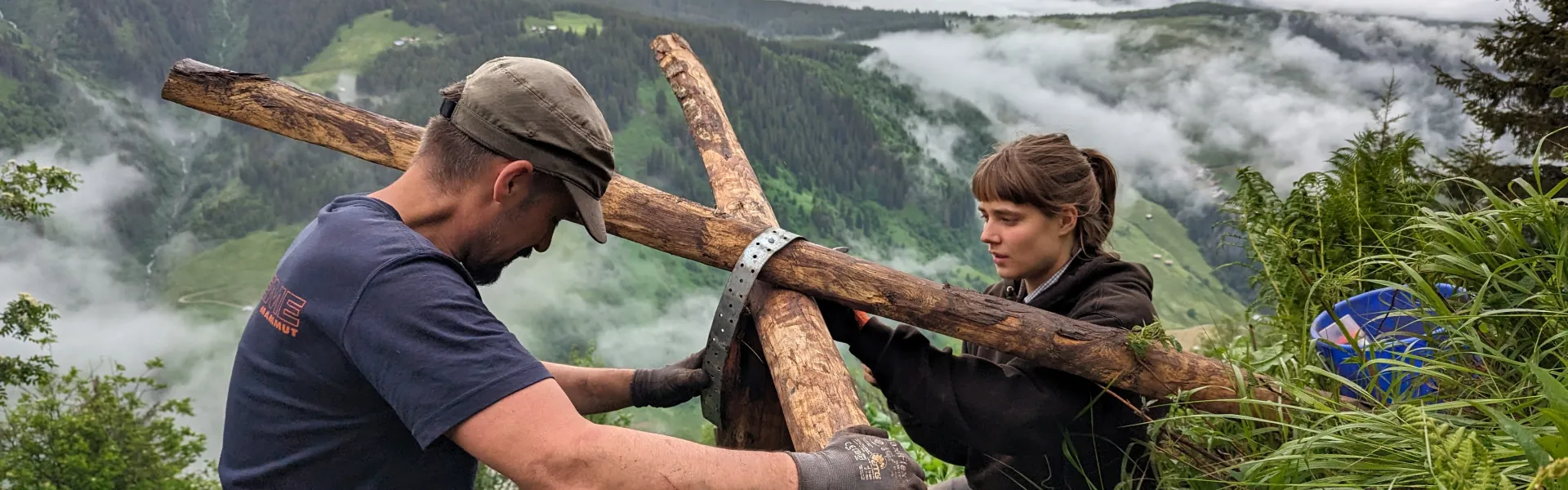
- Construction of tripods: These wooden structures reduce snow pressure and secure young growth above the tree line.
- Clearing: Clearing small sites favorable for regeneration and forming branch piles.
- Cultural landscape management: Keeping meadows and pastures open to preserve biodiversity in regions where traditional use is declining.
- Combating invasive neophytes: Removing alien plant species that threaten native ecosystems.
The type of accommodation varies depending on the project - from simple, remote alpine and forest huts without electricity and hot water to comfortable group accommodation. In some cases, an overnight stay in a tent is also desired.
Young people in school classes and youth groups spend the night in simple group accommodation with electricity and water.
Details on the respective accommodation are listed in the corresponding project description under "Organizational matters". It also states whether overnight accommodation in a tent is possible.
Our simple cuisine is as regional, seasonal and organic as possible, with little meat. At lunchtime, we usually serve soup or cold dishes from the forest.
Vegetarian alternatives are always available. However, vegan Food cannot be guaranteed. Any intolerances should be indicated under "Comments" when registering.
In the case of complex intolerances, the cooking staff will do their best to take this into consideration. In such cases, it is advisable to bring your own food.
The basic equipment for a Bergwaldprojekt week includes:
- clothing adapted to the mountain weather with a spare for rainy days
- sturdy and high mountain boots with a good tread sole (two pairs recommended)
- work clothes, work gloves
- good rain protection (rain jacket, rain pants, gaiters recommended)
- sun protection (sun cream, sunglasses, Headgear)
- warm clothing (we are in the mountains)
- slippers
- headlamp or torch
- daypack, pocket knife, water bottle (thermos flask recommended)
- hand/shower towel
- personal items
Depending on your accommodation, you will also need:
- Sleeping bag, sleeping mat, pillowcase, fitted sheet/duvet cover
You can find a packing list in the respective project description under "Organizational matters".
Depending on the accommodation, it may not be possible to arrive with a suitcase, as all luggage must be well packed and carried up to the accommodation in a rucksack (this is noted in the project description)
Participation in a Bergwaldprojekt week for adults is basically free of charge, food and accommodation are provided. Only arrival and departure as well as insurance must be organized and financed by the participants themselves.
For projects with school classes, youth groups or families, a contribution towards expenses is charged. The costs for company projects depend on the number of participants and are covered by the company.
No, for data protection reasons, no contact details may be passed on. You can exchange information with other participants in your profile on the project page. Shared contact details are displayed there. For emergencies on the day of arrival, the telephone number of the project management will be announced shortly before the start of the project
Yes, you can download a confirmation of your stakes on your dashboard
No, you cannot bring your dog with you. Please organize someone to look after your pet while you are away.
Information on donations
Donations are used effectively and sustainably. The Bergwaldprojekt carefully selects, monitors and continuously improves projects. ZEWO certification guarantees that funds are used for their intended purpose, effectively and economically.
Recognition as a charitable organization by Zewo means that regular checks are carried out to ensure that donations are used for their intended purpose, effectively and economically. As a holder of the seal of approval, we guarantee serious and transparent work and assure our donors that their contributions are handled with care.
The Swiss certification body Zewo certifies organizations that collect charitable donations. In doing so, the Zewo Foundation strengthens society's trust in charitable activities. Organizations that bear the Zewo seal of approval provide open information about their activities, keep transparent accounts and have a functioning external and internal control structure.
Yes. We send out a donation receipt in January of the following year, which shows cumulative donations over an entire year. This certificate can be used for tax deduction purposes.
Yes, the Bergwaldprojekt and its volunteers are committed to protecting the mountain forests and for future generations. With an inheritance or legacy, this commitment can be supported beyond your own lifetime.
➨ If you are interested & have any questions: skoller@bergwaldprojekt.ch 081 650 40 42
Yes, the Bergwaldprojekt has already received several forest areas as a legacy. These are carefully maintained.
➨ If you are interested & have any questions: skoller@bergwaldprojekt.ch 081 650 40 42
Yes, donations in kind are generally possible. However, we are reliant on the donations matching our existing stock of equipment and being standardized. For example, a single chainsaw that is not compatible with our other equipment is of little help to us, as we would also have to ensure spare parts and maintenance. If you are considering a donation in kind, it is best to talk to us first - so we can clarify together where there is a current need.